The first time I saw a sales team actually enjoy their CRM, it was monday.com. Not because it was more powerful than what they had before, but because they could move a card, add a column, and see their week without asking anyone for help. That is a real advantage, and it is also the beginning of the problem.
monday CRM is built on monday.com’s board engine. It inherits the flexibility, the visual polish, and the fast onboarding that made the parent product popular with operations teams. It also inherits some structural limits that show up once a sales team grows past a handful of people. Both sides deserve an honest look.
A board is the product
In monday CRM, a deal is an item on a board. Columns hold your data, groups represent pipeline stages, and automations move items between groups when conditions are met. It is immediately legible. Anyone who has used a spreadsheet can understand it in ten minutes, which is more than most enterprise CRMs can claim.
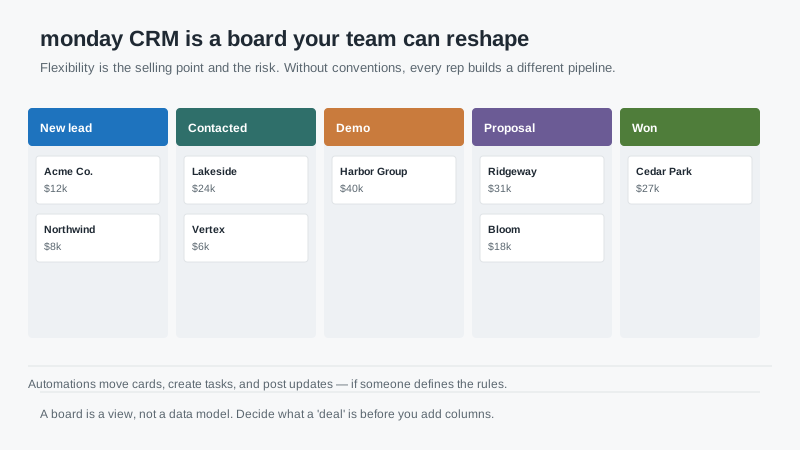
The catch is that a board is a view, not a data model. Every team that adopts it has to decide, early and explicitly, what a deal is, what a contact is, and how the two relate. If you skip that, you get four boards that each define “customer” differently and no way to roll them up.
Where it genuinely wins
Nonstandard processes. If your sales cycle has steps that do not fit a textbook funnel, monday lets you build the shape you actually use. A commercial roofing company I know tracks jobs through estimate, permit, install, and inspection on one board. A generic CRM would have required custom objects and a consultant. Here it was an afternoon.
Adoption speed. The interface is visual and forgiving. Reps who resist CRMs tend to tolerate this one because it looks like a tool they already understand. In the first ninety days, adoption is worth more than feature depth.
Cross-team visibility. Because the parent platform is often already used by operations, marketing, or project teams, sales can sit next to the rest of the company without a second system. That shared context is hard to buy.
Price transparency. Per-seat pricing with clear tiers and a three-seat minimum is easier to model than contact-tier pricing. For a small team, the number is predictable.
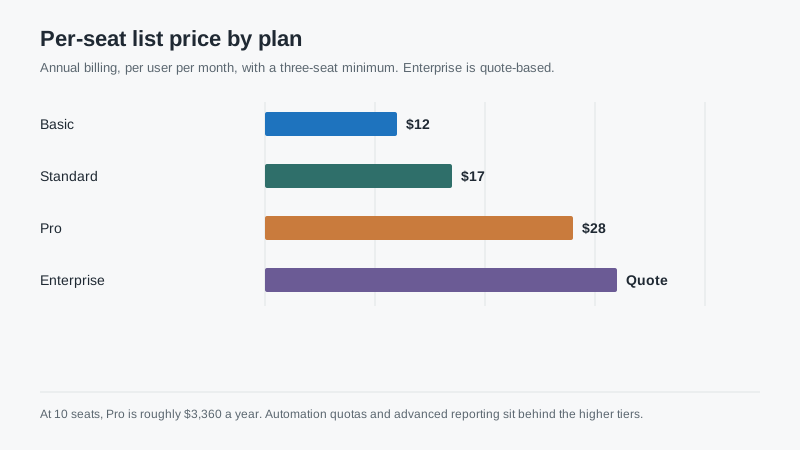
At 10 seats on the Pro plan, you are looking at roughly $3,360 a year on annual billing. That is a fraction of what the enterprise platforms cost at the same headcount, and for many teams it is enough software.
Where it struggles
Email at scale. monday CRM can connect an inbox and log activity, but it is not an email marketing platform and it is not a sequencing engine. If your sales motion depends on multi-step outbound sequences with branching logic, you will end up bolting on a separate tool.
Reporting depth. Dashboards are good for operational views and weak for analytical ones. Multi-object reporting, cohort analysis, and attribution across a long cycle require workarounds. Teams that live in their reports tend to feel this by month six.
Data model rigidity in disguise. Boards connect to other boards, and those connections are powerful. They are also easy to misconfigure. I’ve run into a setup where the same contact existed as an item on three boards with three different owners, and nobody could say which one was authoritative.
Permissions. Granular permissions exist, but they are less nuanced than what a larger sales org with territories and managers needs. If you must hide certain deals from certain reps at the record level, test that carefully before you commit.
Service and support. If you need ticketing with SLAs, knowledge bases, and customer portals, monday CRM is not the right primary system. It can approximate it. Approximation gets expensive at scale.
What it costs beyond the license
The license is the easy part. The hidden cost is structure. Because the platform lets anyone add a column or a board, it accumulates entropy faster than a rigid CRM. Six months in, you have 40 columns, 12 of them unused, and an automation that fires three times for the same deal.
Budget for a cleanup cadence, not a cleanup project. One person should own the board architecture and review changes monthly. That is a few hours a month, and it is the difference between a system that stays legible and one that becomes a shared junk drawer.
Also budget for the automation quota. Higher tiers include more automation runs, and a busy board can consume them faster than expected. If you are running round-robin assignment, stage-change notifications, and task creation on every deal, check the quota against your actual deal volume.
Who it fits
It fits teams of 3 to 30 with a sales process that is still evolving, especially when the rest of the company already uses monday.com. It fits companies that value adoption and visibility over analytical depth. It fits owner-led sales teams where the person running the pipeline is also the person who will configure the board.
It fits less well for teams with complex territories, commission logic, or a large outbound motion. It also fits less well when the CRM must be the system of record for finance and service as well as sales. At that point you are asking a board tool to be an ERP-adjacent platform, and the workarounds stack up.
If you are comparing it against the bigger platforms, our CRM shortlist guide scores monday on the same criteria as the rest, and the team-shape breakdown shows where it lands for field sales versus inside sales.
The trial that tells you the truth
Ask for a trial with your real pipeline, not a demo board. Import 200 actual deals and see whether the columns you thought you needed survive contact with the data. Ask how automations are counted and what happens when you hit the limit. Ask what the export looks like, including subitems and activity history, because that is where exit costs hide.
Ask who will own the board structure after launch, and write that name down. If the answer is “everyone,” you have found your first problem.
monday CRM is a good product with a clear trade-off: you get flexibility and speed, and you pay for it in structure and analytical depth. For a lot of small teams, that is the right trade. Just make it on purpose.

