Every few weeks someone lands on this site after searching “NYSE CRM” and expects a product review. What they usually want is one of two things: the stock ticker, or an explanation of why a customer relationship management search returns a stock quote. Both are fair questions, and the answer is simpler than the search results suggest.
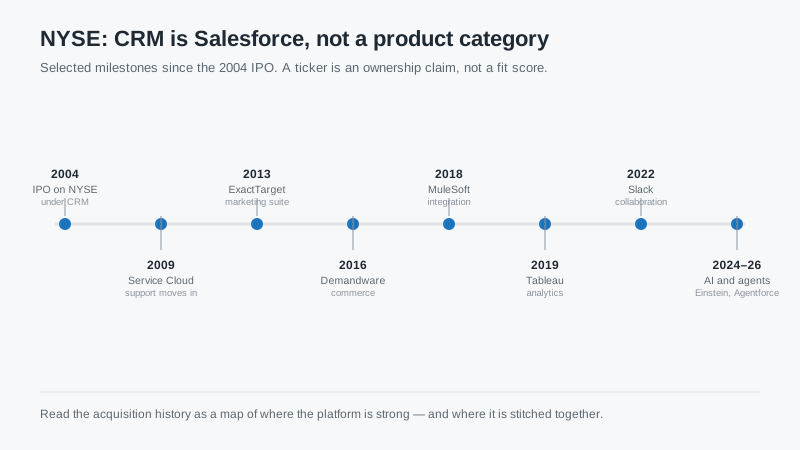
CRM is the ticker symbol for Salesforce, Inc. on the New York Stock Exchange. The company has traded under that symbol since its initial public offering in June 2004. So “NYSE CRM” does not refer to a CRM platform category, a certification, or a separate product. It refers to one company’s listing.
That matters to buyers more than it sounds like it should, because the ticker is often the first thing people find and the last thing they should use to make a purchasing decision.
Why the ticker is CRM
Salesforce took the symbol because the company’s original pitch was “no software,” and the CRM abbreviation was the clearest three-letter version of its category. The listing predates most of the products buyers now associate with the brand, including Service Cloud, Marketing Cloud, and the analytics and integration businesses the company acquired later.
Two other details are worth knowing if you are reading filings. Salesforce’s fiscal year ends January 31, not December 31, so its “fiscal 2026” covers the twelve months ending January 2026. And the company reports subscription and support revenue separately from professional services, which is a useful distinction for anyone trying to understand how much of the business depends on customers needing help to implement the product.
It is also worth clearing up a common confusion: HubSpot, the other CRM vendor most buyers compare against, trades on the NYSE as well, under the symbol HUBS. So a search for “NYSE CRM” can surface both companies. Only one of them has CRM as its ticker.
What a ticker does not tell you
A stock price is a claim on future cash flows. It is not a measure of product fit, implementation quality, or whether a vendor will answer your support ticket in year four. I’ve watched buying committees treat a rising stock chart as evidence that a platform is right for a 40-person sales team. That is a category error, and an expensive one.
What filings can tell you is where a company is investing. If research and development spending is rising faster than revenue, the roadmap is probably aimed at new capabilities rather than fixing the edges of existing ones. If professional services revenue is growing, more customers are paying for help to deploy. If operating margins are expanding, expect less discounting and firmer renewal terms.
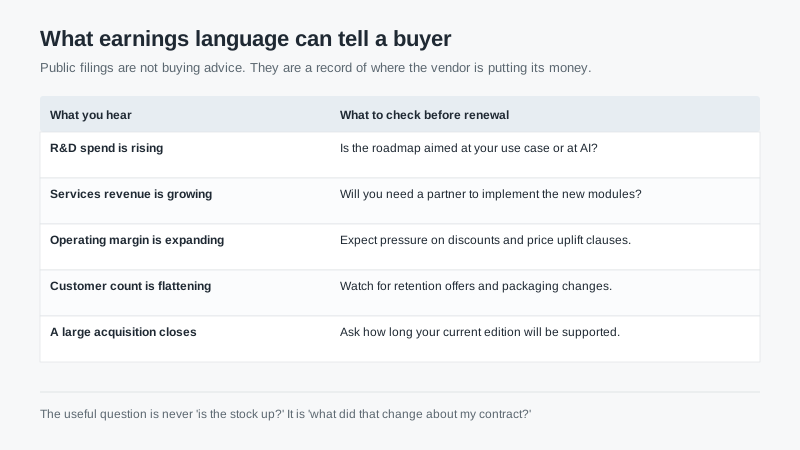
None of this is inside information, and none of it is investment advice. It is public language that a careful buyer can read for practical signals about pricing pressure, roadmap direction, and how much of the product’s value requires a partner to deliver.
What the acquisition history means for buyers
The timeline above is not trivia. Each acquisition explains a strength and a seam.
ExactTarget brought marketing automation, which is why Marketing Cloud exists and why it still feels different from the core sales product. Demandware brought commerce. MuleSoft brought integration, which is the reason Salesforce can credibly sit in the middle of a messy enterprise stack. Tableau brought analytics, and Slack brought collaboration. The AI products that followed are built on top of all of it.
For a buyer, the practical lesson is that “Salesforce” is not one product with one release cycle. It is a portfolio. Pricing, support, and roadmap cadence differ across clouds, and an implementation partner strong in Sales Cloud may be weak in Marketing Cloud. Ask which cloud, which edition, and which team inside the company actually owns that product’s roadmap.
Reading a quarter without overreading it
If you follow the company because you are a customer or a prospective one, three numbers are more useful than the headline revenue figure.
Current remaining performance obligation. This is contracted revenue not yet recognized. Growth here tells you how much future work is already sold, which affects how much attention new customers get relative to existing ones.
Subscription and support margin. Margin pressure often shows up as packaging changes before it shows up as price increases. Watch for features moving between tiers.
Customer count and attrition commentary. If growth is coming from existing accounts rather than new ones, expect more emphasis on upsell motions and less on small-team pricing.
Again, this is buyer intelligence, not a trading strategy. The point is to notice packaging and pricing shifts early enough to model them into your renewal.
What to do with this if you are shopping
Ignore the chart. Use the filings for two things: understanding where the product is headed, and predicting how the vendor will price in eighteen months. Then run your own evaluation on your own data.
Ask your account executive which cloud is receiving the most investment in your segment. Ask how the last two acquisitions changed the roadmap for the products you actually own. Ask whether your edition is on the long-term support path or the legacy one. Those questions are answerable, and the answers are more useful than any analyst note.
If you are early in the process, our Salesforce cost and fit guide covers editions and first-year budgets, and the SFDC explainer unpacks the shorthand you will hear from partners and job postings. If you are weighing alternatives, the CRM shortlist guide puts the three-year cost ranges side by side.
The short answer
NYSE CRM is Salesforce’s ticker. It is not a product line, a certification, or a separate CRM. If you came here looking for software, the symbol is a distraction; the useful work is in edition selection, data cleanup, and admin capacity. If you came here looking for the company, remember that a public listing measures a business, not your fit.
And if a vendor ever tells you their stock price proves the product is right for you, ask them to show you the implementation reference instead. That is the number that actually predicts your outcome.

