There is no best CRM. There is a best CRM for a 12-person inside sales team selling $8,000 annual contracts, and a different one for a dealership with a BDC, and a different one again for a consultancy where the partner is the sales process. Anyone who gives you a single answer without asking about your team is guessing.
What I can give you is a decision process that has held up across the selections I have worked on, plus the shortlist I would start with for four common team shapes. Take the logic and ignore the specific names if your situation is different.
Start with two questions
Before features, before pricing, before the demo: how do you sell, and who will run the tool?
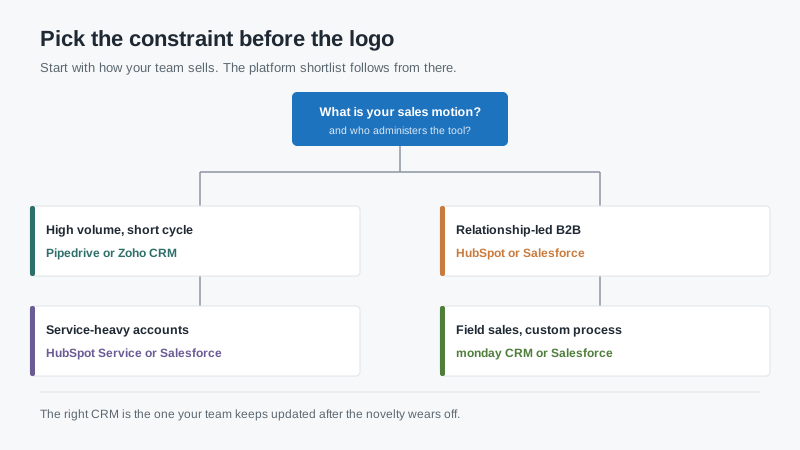
The first question decides the feature set. A high-volume transactional motion needs speed, sequences, and routing. A relationship-led B2B motion needs account history, activity capture, and a shared view of the customer. A service-heavy account base needs tickets and renewal dates next to the deal. Field sales needs mobile-first design and a process that tolerates poor connectivity.
The second question decides the platform. If you have a dedicated administrator, you can absorb complexity. If the owner runs the CRM between sales calls, you need something that configures itself.
Most bad CRM purchases answer the first question and ignore the second.
The shortlist by team shape
This is a starting point, not a verdict. Each row assumes a team that has not already standardized on a platform.
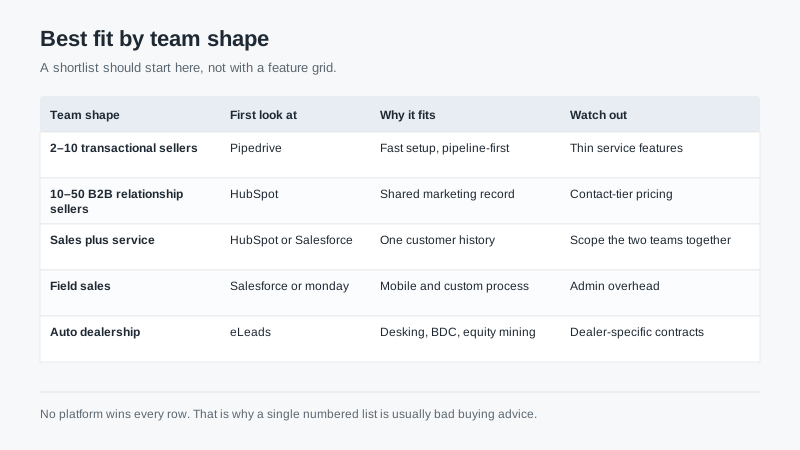
Two to ten transactional sellers. Start with Pipedrive. It is pipeline-first, fast to learn, and priced per seat. You will outgrow its reporting before you outgrow its pipeline. That is a good problem, and cheaper than the reverse.
Ten to fifty B2B relationship sellers. HubSpot is the default for a reason: one record shared by sales and marketing, a free tier to test, and an interface people actually use. The contact-tier pricing is the thing to model carefully.
Sales plus service. Either HubSpot or Salesforce, depending on complexity. Scope the two teams together. The most common failure I see is buying for sales and discovering in month four that the service team needs a ticket object that does not exist in the edition you chose.
Field sales with a custom process. Salesforce if you have an admin, monday CRM if you do not. Salesforce bends further; monday bends faster. Pick based on who is doing the bending.
Auto dealership. eLeads or a comparable dealer-specific platform. The desking, BDC, and equity mining workflows are not worth rebuilding in a generic tool.
The week that decides it
Do not run a three-month evaluation. Run a focused week with three finalists.
Monday: send each vendor your three worst deals from the last quarter and ask them to walk the workflow live. No slides.
Tuesday: import 500 real accounts and 2,000 contacts into each trial. Use the messy file. Time the import and count the duplicates.
Wednesday: have two actual reps, not managers, try to complete one task each. Watch where they hesitate. Hesitation from a rep is worth more than enthusiasm from a sales engineer.
Thursday: ask each vendor for the export file and open it. Check whether notes, attachments, and activity history survive.
Friday: read the contract. Specifically the renewal uplift, the seat true-up, the data export clause, and the termination notice window.
By Friday afternoon you will know more than a month of demos would tell you.
What actually predicts success
In the projects that worked, three things were true regardless of platform.
The forecast came from the CRM and nowhere else. The moment a parallel spreadsheet exists, the CRM becomes optional.
Required fields were few and meaningful. Every field a rep has to fill is a small tax. If a manager would not act on the value, the field should not be required.
Someone owned the system by name. Not a committee. A person with hours allocated and the authority to say no to new fields.
Notice that none of those are features. Platforms differ at the margins, but the failure mode is almost always organizational. A mediocre CRM with a disciplined team beats a great one with a spreadsheet shadow system.
What to pay, roughly
For a 20-person team, three-year subscription costs land anywhere from about $6,000 to $120,000 depending on platform and edition. That is an enormous range, and most of it is explained by two decisions: which edition you buy and whether you negotiate.
Implementation is separate. A simple deployment can be configured in a week by someone competent. A complex one with integrations and dirty data can run six months. Do not let a vendor quote implementation before they have seen your data.
Internal time is the line to protect. Whatever the proposal says, assume 500 to 1,200 hours in year one for a team this size, spread across sales, operations, and whoever ends up as the accidental admin.
Three questions that separate good vendors from good salespeople
“What will we stop doing after this goes live?” A vendor with a real answer has thought about adoption. A vendor who says “nothing, it adds visibility” has not.
“Show me a customer like us that left.” Every platform has churn. The answer tells you about the exit experience and whether the vendor is honest about fit.
“Who is on our project at kickoff, and how many other projects are they running?” This one question predicts timeline slippage better than any reference call.
The answer, such as it is
For most small and mid-sized B2B teams, the best CRM is HubSpot if marketing and sales need one record, Pipedrive if the pipeline is simple and speed matters, and Salesforce if the process is genuinely complex and you can fund an admin. monday CRM is the right call when flexibility and adoption matter more than analytical depth. Zoho is the value option that keeps more of the budget for implementation.
None of that is true if you cannot name who owns the system, or if the forecast still lives in a spreadsheet. Fix that first. The platform decision gets much easier once the process is written down.
If you want the evaluation criteria in more detail, the CRM software shortlist guide breaks down scoring and cost ranges. If budget is tight, start with the free tier comparison and earn your way to a paid platform.

